
The REAL Mark Method for Slow Viewing
Five steps to stay with one painting, and to carry it with you.
Seventeen seconds.
In a 2001 study at the Metropolitan Museum of Art, Jeffrey and Lisa Smith found that half of all visitors give a masterpiece no longer than that.
A bit short for a painting that spent months on the easel.
Slow viewing asks for the opposite: one painting, with your full attention, building visit by visit toward fifteen minutes. Sounds simple. But in the contemplation workshops I lead, around minute four, almost everyone feels the itch to move on.
So I created the REAL Mark Method, five steps to carry you past that moment. First visit or fiftieth, bring your feet, your breath, your eye, and let the painting stir the rest.
Root. Plant your feet and feel the floor beneath you. Let your body arrive in the room first. Your attention will follow.
Exhale. Breathe out slowly. Let go of the list, the schedule, the next thing. There is nothing to accomplish here.
Admire. Curl your hand into a small window and frame one thing that delights you, a color or a shape. Let it lead. Where does that blue wander? Where does it deepen, or fade?
Linger. Notice what it stirs: a memory, a feeling, a question. There is no right answer, only yours. When your mind drifts, curl your hand, mark a spot, the same one or a new one, and dive back in. The restlessness is a doorway, not a signal to look away.
The restlessness is a doorway, not a signal to look away.
Mark. Every return is a mark. Before you leave, curl your hand once more, breathe out, and take a close-up photo of the detail that left the deepest mark. Keep it for the next moment.
Why a fifth step
Mark is a painter’s gesture. Curl your hand into a small window and the world narrows to one detail, the way it does when I step back from a canvas to decide what it needs. That small window is your cue. Each time the mind drifts, it brings you back.
The last mark does two things. It marks this moment, so it stays with you. And it sets you on your mark for the next one. The photo isn’t a souvenir of a painting. It’s a way back into the attention you reached, the next time you need it: at a dinner table, on a walk at dusk, beside someone you love.
Build up to fifteen
Like any practice, slow viewing grows with you. Start with five minutes, just past the moment the restlessness comes. On your next visit, try ten. Fifteen is where a painting truly opens.
Before you begin, read the REAL Mark card below once. Then put your phone away, and take it out only for that last close-up. From there, the painting is all you need.
As a painter, I know how much goes into a single brushstroke. When you give a canvas your time, you complete it with your own stories, and part of it walks out of the museum with you. Giving it fifteen minutes is a small act of generosity, to the painting and to yourself.
The next time you walk into a museum, see one thing. For REAL.
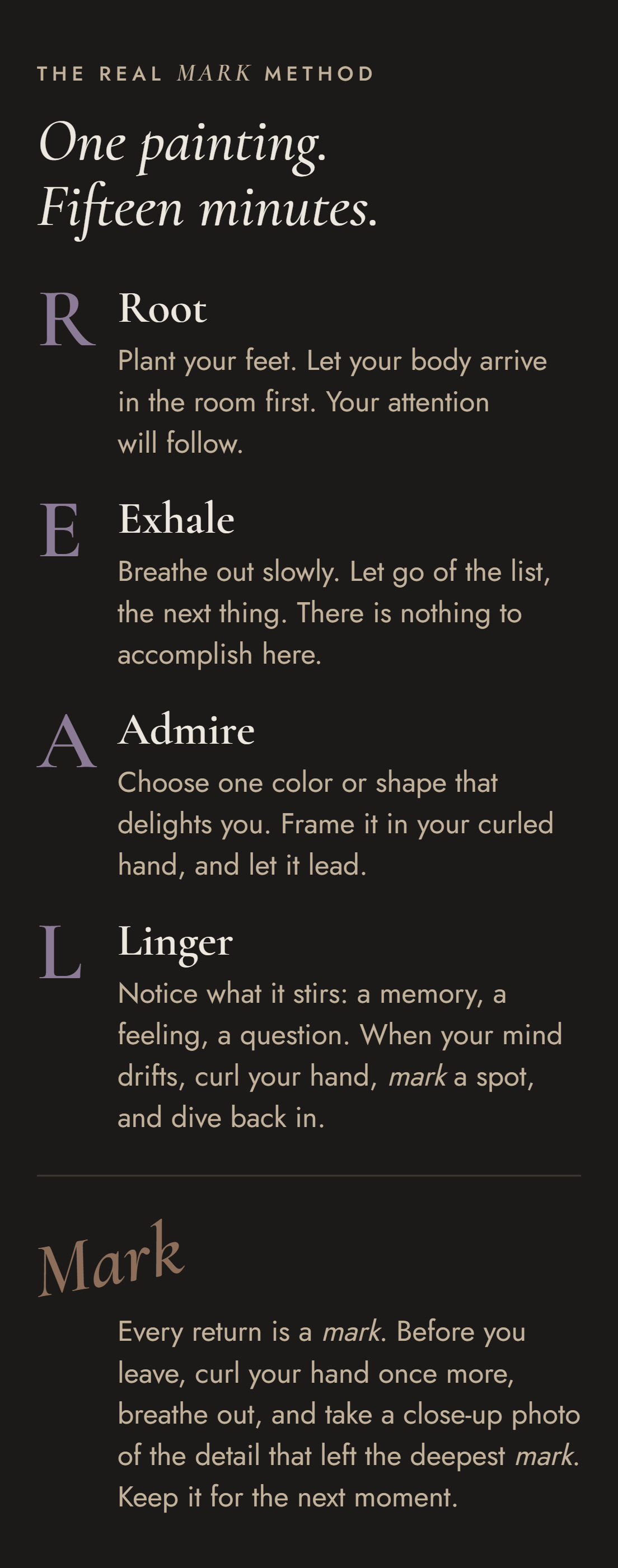
Tap the card to open it full size
Keep exploring
Attention as Generosity
Why attention is the rarest gift we can give.
Read the blogKeep readingThe Colors of the Lot
Where my own way of looking began.
Read the blogContemplationPractice it together
Join a workshopSourcesJeffrey K. Smith and Lisa F. Smith, “Spending Time on Art”, Empirical Studies of the Arts, 2001.
All journal entries